Mold Removal Cost in Delhi NCR (2026 Guide): What You’ll Actually Pay, and Why
Mold on your bathroom ceiling or that damp patch spreading behind the bed isn’t just ugly — it’s a sign of trapped moisture that needs to be addressed properly. If you’re dealing with an active mold problem, our professional mold removal service in Delhi NCR includes assessment and treatment based on the condition of the affected area.
This guide breaks down exactly what decides your mold treatment cost or mold removal cost Delhi or mold remediation cost in Delhi Gurgaon, Noida, Faridabad and Ghaziabad, what a fair price actually looks like, and a room-by-room cost table you can use to sanity-check any quote you receive — including ours.
How much does mold removal cost in Delhi NCR?
Mold removal in Delhi NCR can range from around ₹2,000 for a small, localized treatment to ₹40,000 or more for extensive whole-home treatment. The final cost depends mainly on the affected area, severity of the infestation, surface type, accessibility, moisture source and number of treatment sessions required. For a more detailed breakdown, see our Mold Removal Cost by Room Size table below.
Mold Removal Cost by Room Size (Delhi NCR, 2026)
| Area | Estimated Cost Range |
|---|---|
| Single bathroom | ₹2,000 – ₹3,500 |
| Single bedroom | ₹2,500 – ₹5,500 |
| Double bedroom / double bathroom | ₹4,500 – ₹8,500 |
| Kitchen | ₹2,000 – ₹4,500 |
| Hall / living room | ₹3,500 – ₹7,000 |
| Ceiling | ₹2,500 – ₹6,000 |
| 1 BHK (full home) | ₹6,000 – ₹12,000 |
| 2 BHK (full home) | ₹9,000 – ₹18,000 |
| 3 BHK (full home) | ₹14,000 – ₹28,000 |
| 4 BHK (full home) | ₹20,000 – ₹40,000 |
_>These are estimated ranges only — your final bill will always depend on how bad the mold actually is, how much area it’s spread across, and what’s causing it, so the real number could land above or below this table once we’ve inspected your home.<_
What Decides the Final Mold Removal Cost?
No two mold jobs cost the same because no two mold problems are the same. Here’s what actually goes into the final number:
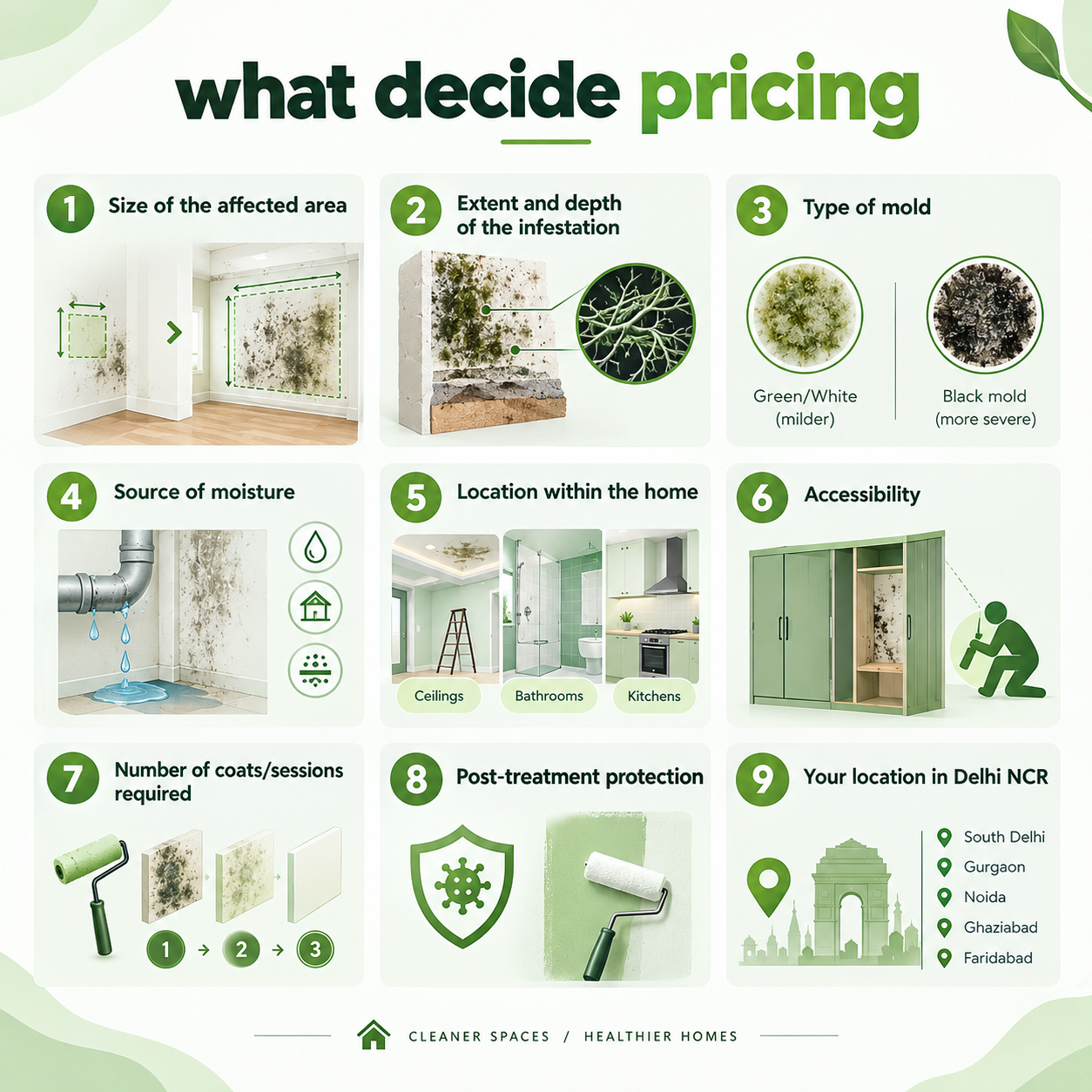
1. Size of the affected area
This is the baseline multiplier for almost every quote. Pest control companies (like restoration companies everywhere) price mold work per square foot because labour, chemical volume, and time scale almost linearly with area. A 1 sq. ft. spot near a window sill might take 20 minutes and one round of spray; a fully colonized 150 sq. ft. bedroom wall can take hours and multiple litres of fungicide. This is also why a quote given over the phone without measurements is almost meaningless — the technician needs to see and measure the actual spread first.
2. Extent and depth of the infestation
If you’re dealing with a smaller mold patch specifically on a painted wall, see our guide on how to clean mold on a wall for more information. But mold that’s been left untreated for weeks or months sends thread-like roots (hyphae) into porous materials — plaster, POP (plaster of Paris), untreated wood, even grout lines. Once it’s rooted, a surface wipe does nothing; the technician has to apply a fungicide strong enough to penetrate the material, sometimes requiring the surface to be lightly scraped or sanded first so the chemical can actually reach the roots. This is the difference between a ₹1,500 job and a ₹4,000 job on the exact same wall, depending only on how long the mold was left untreated.
3. Type of mold
Not all mold is equal. Common household mildew (usually grey, white, or green-ish) is a nuisance but low-risk, and standard fungicide handles it in one or two sessions. Black mold (Stachybotrys chartarum) is a different category — it’s more toxic to handle, requires the technician to wear proper PPE (mask, gloves, sometimes goggles), and often needs the room to be ventilated or lightly sealed off during treatment so spores don’t spread to the rest of the house. That extra precaution and equipment is reflected in the price.
4. Source of moisture
This is the factor that decides whether the job actually solves the problem or just delays it. Mold is a symptom — the real issue is trapped moisture from a leaking pipe, water seeping in from a neighbour’s bathroom, condensation from poor ventilation, or damp that never fully dried after construction. If a company only treats the visible mold and ignores the moisture source, the client is often back to square one in 2–3 months. Identifying the source sometimes means a plumbing referral or a waterproofing recommendation alongside the mold treatment — which is extra diagnostic time, but it’s the part that actually protects the customer’s money long-term.
5. Location within the home
A wall at eye level is the easiest surface to treat — no equipment needed beyond a sprayer and a ladder. A ceiling or a false ceiling is a different job entirely: it usually needs scaffolding or a proper ladder setup, the technician is working overhead (slower, more careful application to avoid drips), and there’s a real risk of loose plaster or debris falling during treatment. Bathrooms and kitchens also get a slightly different (often stronger) fungicide formulation because they stay humid for hours after every use, which gives mold a head start on regrowing versus a dry bedroom wall.
6. Accessibility
This is purely about how easily the technician can physically reach the mold. A wall behind a heavy wardrobe or bed that has to be moved first, a tight utility balcony, the underside of a kitchen platform, or a narrow gap behind a geyser all add time before any actual treatment even starts. Some of this may involve temporarily shifting furniture, which is manual labour that gets baked into the estimate.
7. Drying & dehumidification
Larger or more humid rooms need air dryers/dehumidifiers running longer before the job can be signed off, which adds to session time and cost.
8. Material removal & disposal
If drywall, wood, or false-ceiling panels are too damaged to treat (crumbling, rotted, deeply saturated), they have to be physically removed and disposed of rather than treated — this adds labour and material cost that a simple surface job doesn’t have.
9. Your location in Delhi NCR
Standard, but worth explaining plainly: travel time and local labour rates differ across Delhi NCR. A technician dispatched to South Delhi vs. Greater Noida vs. deep Gurgaon sectors has different commute costs and time built in, and some areas simply have higher prevailing service rates than others. It’s usually a small swing (not the main driver of the bill), but it’s part of why the same job can be quoted slightly differently depending on exact location.
Which Parameters Influence the Price the Most?
Not all of these carry equal weight. In order of actual cost impact:
Area + Extent of spread (biggest factor) → Location in the home (ceiling > wall) → Whether the moisture source needs fixing → Type/severity of mold → Accessibility → Number of sessions needed
In short: a 2 sq. ft. patch on a bedroom wall and a fully mold-covered bathroom ceiling with an active leak behind it are priced worlds apart — even in the same flat.
What’s an “Ideal” Price?
There isn’t one “ideal” price for mold removal because every job is different. A fair quote should reflect the actual area affected, severity of mold, surface condition, accessibility, moisture source and number of treatments required. Instead of choosing the cheapest quote, ask for a clear breakdown of what is included — inspection, mold treatment, drying, surface protection and any additional repair or removal work. A transparent quote that explains what you’re paying for is a better benchmark than a low headline price with important steps left out.
Why Siya Killer Pest Control vs. a Regular Vendor
Most mold “removal” in Delhi NCR is really just bleach-and-scrub — it kills surface growth but doesn’t touch the roots inside porous plaster, POP or wood, so the mold is often back within weeks. Here’s how our approach compares to that standard, one-visit model:
| What Matters | Typical Vendor | Siya Killer Pest Control |
|---|---|---|
| Diagnosis | Sprays visible mold only | Free on-site inspection with moisture-meter testing to trace the actual source before quoting |
| Treatment method | Household bleach/detergent wash | Antimicrobial treatment that penetrates porous surfaces and kills root-level hyphae, not just surface stain |
| Root cause | Rarely addressed | Moisture source (leak, seepage, poor ventilation) identified and fixed as part of the plan |
| Quote | Verbal, round-figure estimate | Written, itemized estimate by area/room before work starts |
| Recurrence protection | Visible mold wiped, moisture source usually left alone | Proper drying/dehumidification plus practical guidance on ventilation and humidity to stop regrowth |
| Air quality | Only the visible surface is cleaned | HEPA-filtered vacuuming and air sanitization to clear residual spores from the air, not just the wall |
| Technicians | General pest/handyman staff handling mold as an extra job | Technicians trained in mold remediation |
| After-service | No follow-up | Post-treatment verification walkthrough |
| Coverage | Limited pin codes | Delhi, Gurgaon, Noida, Ghaziabad, Faridabad and nearby NCR areas |
Frequently Asked Questions
Is professional mold removal worth it?
Yes, if the mold covers more than a small isolated patch, has come back after DIY cleaning, or is on a ceiling/porous surface. Bleach and home sprays only kill what’s visible on the surface — Professional remediation goes beyond removing visible staining: the treatment approach depends on the material, extent of growth and moisture source, and may include cleaning, physical removal, drying or replacement of affected materials, which is the only way to stop it from returning.
How much does it cost to remove mold?
In Delhi NCR, small jobs like a single bathroom or bedroom patch typically run ₹1,500–₹5,500, while a full home treatment ranges from ₹6,000 for a 1 BHK to ₹40,000 for a large 4 BHK. See the table above for a room-by-room breakdown.
What permanently kills mold?
A third-generation broad-spectrum fungicide applied deep enough to reach the hyphae (root structures) inside the surface, followed by fixing the moisture source and applying an anti-fungal sealant. Bleach alone doesn’t count — it can’t penetrate porous surfaces like wood, plaster or concrete enough to kill the roots.
Can mold be completely removed?
Yes, from the surface and material it’s growing in. But it will always come back if the underlying moisture source — a leak, seepage, or poor ventilation — isn’t fixed alongside the treatment.
Is it okay to stay in a house with mold?
Small, contained patches usually aren’t an emergency, but prolonged exposure — especially to black mold — can trigger allergies, asthma flare-ups, and respiratory issues, particularly in children, elderly residents, and people with existing conditions. It’s best treated promptly rather than lived with.
Why is mold removal so expensive?
It isn’t just cleaning — it’s diagnosing the moisture source, using specialised fungicides (not household bleach), sometimes working with scaffolding for ceilings, and applying protective sealants so it doesn’t return. Cutting any of these steps is usually why cheap mold jobs fail within months.
Can a house with mold be saved?
Almost always, yes. Even heavily affected homes can be fully remediated — the cost simply scales with how much needs to be treated and whether any structural drying or repair is needed alongside it.
Do air purifiers help with mold?
They can reduce airborne spores and improve air quality while you deal with the problem, but they don’t remove the mold growing on your walls, ceiling or furniture. Think of them as a supplement to treatment, not a replacement for it.
How long does mold removal take?
A single room typically takes a few hours to a day, including drying time between coats. A full 2–3 BHK home usually takes 1–2 days depending on the extent of the spread and number of sessions needed.
What not to spray on mold?
Avoid mixing bleach with ammonia-based cleaners (it releases toxic fumes), and avoid painting directly over mold without treating it first — the mold keeps growing underneath the paint and resurfaces later.
How to 100% get rid of mold?
Treat the visible growth with a proper fungicide, fix the moisture source causing it, and seal the surface afterward. Skipping any one of these three steps is the most common reason mold “removal” doesn’t actually last.
What is the best homemade mold killer?
Want to understand the different ways mold can be removed? Read our detailed guide on how to get rid of mold and prevent it from coming back.
Can mould make you sick?
Yes — prolonged exposure is linked to respiratory irritation, allergic reactions, and worsened asthma symptoms, especially with black mold. If anyone in the home has ongoing unexplained coughing, sneezing or breathing issues, it’s worth checking the home for hidden mold.
How do I prevent mold from growing?
Keep humidity in check with ventilation or exhaust fans, fix leaks as soon as you spot them, wipe down damp bathroom/kitchen surfaces regularly, and avoid sealing up freshly plastered walls before they’ve fully dried and cured.
What are the guidelines for mold cleanup ?
The CDC and EPA guidelines for mold cleanup generally recommend the following steps: fix the moisture source first (cleaning without stopping the leak or humidity means the mold returns), wear protective gear (N95 mask, gloves, and goggles to avoid inhaling or touching spores), isolate the area if possible (close doors, use plastic sheeting for larger patches to stop spores spreading to other rooms), remove porous materials that can’t be fully cleaned (absorbent items like soaked drywall, carpet, or ceiling tiles usually need to be discarded rather than treated), clean hard surfaces properly (scrub with detergent and water or a mold-specific cleaner, then dry completely — trapped moisture after cleaning is what lets mold return), and ventilate the space (keep the area well-aired and use fans or a dehumidifier during and after cleanup).
Ready for an accurate mold removal quote? If you’re in Delhi NCR, you can learn more about our mold removal service or call 9354539833 to arrange an on-site inspection.
Siya Killer Pest Control | second floor, 116-B, Shahpur Jat, Siri Fort, New Delhi, Delhi 110049 | 9354539833